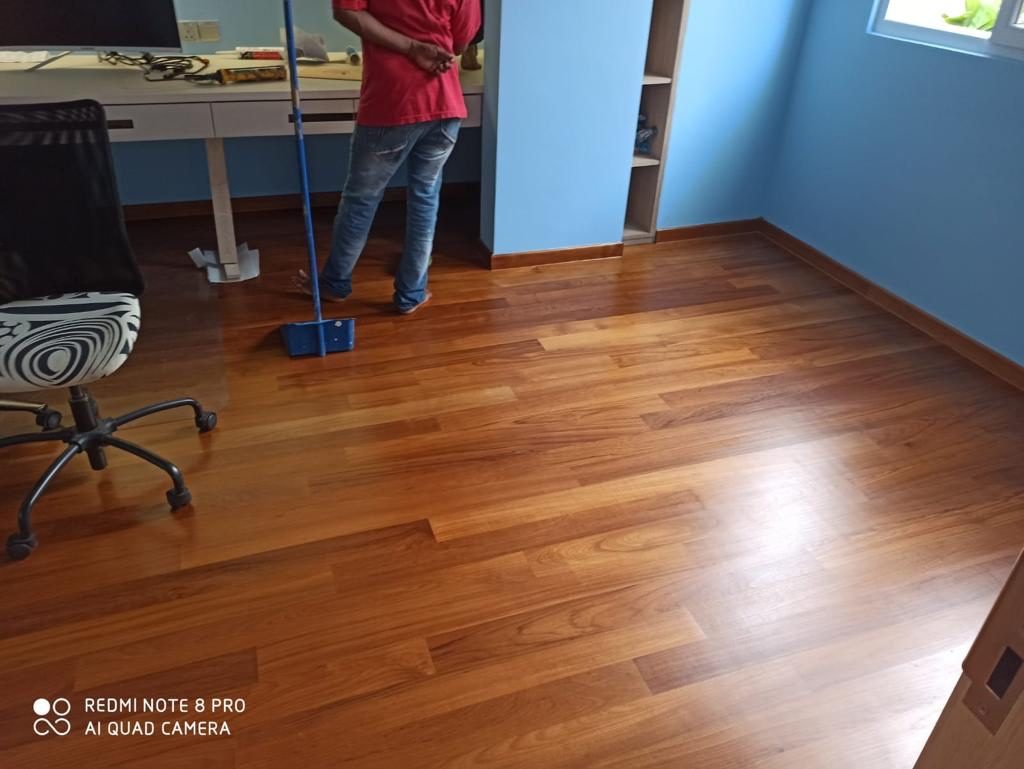
We are a wood-flooring contractor. We do not install vinyl, SPC, laminate or bamboo, and this article is not a vinyl-product comparison page. It is the conversation we have with prospective clients who are still deciding between a real-wood floor and a vinyl-family product, and want a candid view of where wood is — and is not — the right call.
There is nothing wrong with vinyl as a category. Vinyl has gained share in Singapore for legitimate reasons. The point of this article is to lay out the genuine differences so the homeowner can choose the floor that fits the actual use case, rather than the floor the salesman in front of them happens to stock.
Where the two are genuinely different
Material
Wood flooring — parquet, solid timber, engineered wood — is real wood on the surface. The grain, colour variation, soft-but-resilient feel underfoot and the way it ages are products of biology. Engineered wood combines a real-hardwood wear layer on a cross-grain plywood or HDF core for dimensional stability.
Vinyl flooring is a polymeric plank or tile, usually PVC-based, with a printed décor layer protected by a clear wear film. Stone-Plastic Composite (SPC) and Wood-Plastic Composite (WPC) sub-types use rigid mineral or wood-flour cores. The grain pattern is a high-resolution print, not the surface of the material itself.
That distinction is not a value judgement — it is the technical reality. Decisions follow from it.
Refinishability
A wood floor can be sanded back to bare wood and refinished. A 14–21 mm solid plank gives three or four full sanding cycles; an engineered floor gives one to three sandings depending on wear-layer thickness; a parquet floor lasts decades. The principle is set out in AS 4786.2:2005 Timber — Sanding and finishing of timber floors and is the basis for our sanding work.
A vinyl floor cannot be sanded. When the wear layer is breached, the décor print is exposed and the floor is replaced, not refurbished. That is a different cost profile over a 20-year horizon and a different waste profile at end of life.
Water tolerance
Vinyl tolerates standing water for hours without permanent damage. Wood does not — a wet event of more than a few hours risks cup, stain or bond loss, and a sustained leak risks structural damage. For unit-above leaks, balcony overflow risk and aircon condensate failures, vinyl is genuinely more forgiving.
The mitigation on the wood side is competent moisture control and rapid response. We measure with calibrated meters using the principles of ASTM D4442 on every install and on every water-damage assessment. A monitored, intact wood floor in a unit with a working aircon is not a high-risk floor; the risk is mostly from one-off accidents, not from normal use.
Sustainability and material origin
Wood is a renewable material. Responsibly-sourced timber — FSC or PEFC chain-of-custody — is a low-impact specification choice. The relevant framework documents are FSC Chain of Custody (FSC-STD-40-004) and the EU Deforestation Regulation context referenced in EU FLEGT / EUTR documentation.
Vinyl is a petrochemical product. End-of-life options are limited; recycling streams for post-consumer LVT are not widely available in Singapore.
If material origin matters to the homeowner, certified wood is the more direct answer.
Indoor-air and VOC
Both categories have made significant progress on emissions. Modern water-based wood varnishes are well within the limits of EU Directive 2004/42/EC on VOC content. Modern phthalate-free vinyl is similarly well-behaved.
The conversation worth having is not "which is lower VOC" but "what specifically is in the product we are about to install". We share manufacturer data sheets and VOC declarations for the wood and varnish we propose. Where indoor-air sensitivity is the driver — infants, asthma, sensitive occupants — a water-based 1K or 2K wood varnish system installed in a ventilated unit is one of the cleaner specifications available.
The local regulatory direction is set out under the Environmental Protection and Management Act; from 1 January 2026, NEA Singapore restricts the formaldehyde content of interior architectural paints sold in Singapore — see the NEA website for the gazetted notification. Wood-floor varnish is not the headline category, but the direction of travel is clear.
Feel, sound, and how it shows in photographs
This is the hardest to write about because it is partly subjective. The two consistent observations from clients who have lived with both:
- Wood is warmer and softer underfoot than vinyl, by a noticeable margin. SPC in particular is quite hard.
- Wood scatters light differently. A satin-finished wood floor catches the afternoon sun in a way that a printed décor layer does not quite replicate.
On photographs at typical resolution, mid-range vinyl can look close to mid-range wood. In person, in raking light, the difference is straightforward to see.
Where vinyl genuinely fits
We are willing to say it, and so do most honest wood contractors:
- Rental units with high tenant turnover — refinishability is not captured in the lifecycle; water tolerance and replacement cost matter.
- Wet zones — kitchens with frequent spills, laundries, ground-floor units adjacent to outdoor wet areas.
- Short-horizon refurbishments — a 5–7 year hold where the next owner is likely to redo the floor anyway.
- Tight renovation budgets — at the absolute entry tier, vinyl gets the homeowner to "new floor" sooner than even budget parquet.
In any of these cases, we will say so on site. We are not the contractor to call for those projects.
Where wood genuinely fits
- Long-horizon family home — 15+ year occupancy where the floor is sanded and recoated once or twice. Lifecycle cost favours wood significantly.
- Visible-luxury interiors — the wood-grain pattern is a material property, not a printed décor. It is hard to replicate on a printed product.
- Landed properties and heritage interiors — traditional Burmese teak parquet, herringbone and chevron patterns. The visual language is wood-specific.
- Owners who care about material origin — certified wood (FSC / PEFC) gives a paper trail that vinyl does not.
- Owners who plan to age in place — wood underfoot is warmer than vinyl over a slab and noticeably softer than tile.
A useful pricing reference
We are not the contractor to quote vinyl. For a wood-side reference, the cost drivers for a wood floor are set out in our companion article Wood floor cost drivers in Singapore, which walks through species, board format, substrate, coating and project conditions.
For a rough cost-of-ownership picture over 20 years on the same room, a refinishable mid-tier wood floor will sit slightly above mid-tier vinyl on purchase price, but the wood floor can be sanded and recoated once or twice during that period instead of being lifted and replaced. The numbers cross in favour of wood somewhere in the second sanding cycle.
How to read a quote from any flooring contractor
Three checks that apply regardless of material:
- Substrate preparation is a separate line, not buried in the per-m² rate. Screed flatness, levelling and remediation are project-specific and should be quantified after a site visit, not estimated.
- The coating or wear layer is specified by product, not by adjective. "Premium varnish" or "high-quality wear layer" is not a specification. The product name, manufacturer and thickness should be on the quotation.
- The warranty terms identify what they cover. A general "10-year warranty" without scope is not informative. We write our warranty against named defects (varnish bond, board joints, install workmanship) with the conditions clearly stated.
What we recommend
Wood is the right floor when the homeowner values material authenticity, intends to live with the floor for years, and accepts that some attention to humidity and water spills is part of owning it. Vinyl is the right floor when the homeowner needs water tolerance, lifts the floor on short cycles, or is working a tight refurbishment budget.
If you are leaning toward wood, we are happy to walk through the choices on site. We will tell you, honestly, where vinyl would have been the better call for your particular use case. Project-specific recommendations and pricing are confirmed in writing per job.
---
References used in this article
- Standards Australia. AS 4786.2:2005 — Timber — Sanding and finishing of timber floors.
- ASTM International. ASTM D4442 — Direct Moisture Content Measurement of Wood and Wood-Based Materials.
- European Parliament and Council. Directive 2004/42/EC on the limitation of emissions of volatile organic compounds.
- Forest Stewardship Council. FSC-STD-40-004 — Chain of Custody Certification.
- National Environment Agency (Singapore). www.nea.gov.sg — formaldehyde notification under the Environmental Protection and Management Act.
Standards are referenced as named documents; full text is available from the issuing bodies and is not reproduced here.