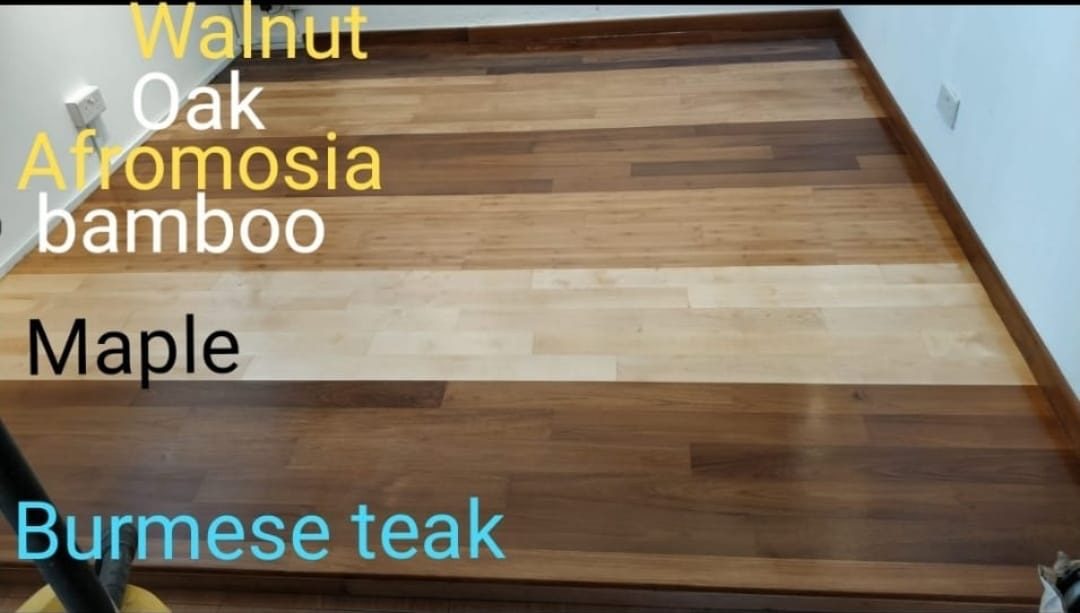
Choosing the species is the first decision on a wood floor. It drives appearance, hardness, dimensional stability, biological durability, refinishing depth and price — and once installed, none of that is easy to change. This article compares the species we install most often in Singapore homes against published timber data and the standards that contractors and architects reference here.
We carry stock and have installed in tropical conditions for over a decade. The notes below are species-specific rather than brand-specific, and are intended as a working reference rather than a marketing pitch.
How species are classified
Two technical references come up repeatedly:
- Janka hardness — a side-grain indentation test that gives a relative number for surface dent resistance. Higher numbers resist heel-strike, dropped objects and furniture point loads better.
- EN 350 — the European standard Durability of wood and wood-based products — Testing and classification of the durability to biological agents (current revision 2016). It classifies natural durability against decay fungi (Classes 1–5) and resistance to insect attack including termites.
- SS 572:2012 — Code of Practice for Timber in Buildings, Singapore. The local code that references species grading and design values for structural timber and is the document architects and PEs cite for timber use in buildings.
For parquet and flooring use, the EN 350 durability class matters most where the floor sits close to wet zones, and Janka matters most for high-traffic living areas with children and pets.
The species we install most often
The values below are typical published ranges. Real boards vary by source and grading, and the figures from one supplier should not be treated as guaranteed by another. Where a project demands a specific minimum value, we ask the supplier for the certificate of origin and grading.
| Species | Janka (N, approx) | EN 350 natural durability | Tone | Where it fits |
|---|---|---|---|---|
| Burmese teak (*Tectona grandis*) | 4,000–4,500 | Class 1 (very durable) | Golden brown, darkens slightly with age | Traditional parquet, landed homes, heritage interiors |
| European / American white oak (*Quercus*) | 5,000–6,000 | Class 2 (durable) | Pale cream to honey | Contemporary planks, condo interiors, herringbone |
| American black walnut (*Juglans nigra*) | 4,500 | Class 3 (moderately durable) | Chocolate brown, sometimes purplish | Feature rooms, dark contemporary schemes |
| Merbau (*Intsia*) | 6,500–7,000 | Class 1–2 | Reddish brown, darkens to mahogany | Heavy-traffic, high-durability strip parquet |
| Kempas (*Koompassia malaccensis*) | 7,500 | Class 2 | Pinkish red | Hard-wearing strip parquet, value option |
| Hard maple (*Acer saccharum*) | 6,400 | Class 5 (not durable) | Pale cream, very uniform | Bright, modern interiors with steady humidity |
Source data: published timber-database values (Wood Database, Janka and physical properties; The Wood Database) and EN 350:2016 Durability of wood and wood-based products. Local supply availability is checked against current stock at quotation.
Reading the table for a Singapore home
A high Janka number on its own is not the same thing as the right floor. Three layered checks usually decide:
- Traffic and load — Kempas and merbau handle the daily abuse of a busy family corridor more forgivingly than walnut or teak. For an adult-only condominium with light traffic, the harder species are overkill.
- Humidity exposure — Teak's natural oils and Class 1 durability rating give it the longest track record in Singapore. Maple, by contrast, is rated Class 5 (not durable) under EN 350 and is not the species we recommend for a floor that occasionally sees wet feet from a balcony or kitchen.
- Refinishing depth — Solid timber gives multiple sanding cycles regardless of species. Engineered boards add a wear-layer constraint that overrides species hardness — a 2 mm walnut wear layer survives one light sand whether the wood underneath is hard or soft.
Dimensional stability in the tropics
Janka measures dent resistance, not movement. For dimensional stability under Singapore's 75-90% outdoor RH, the relevant published figures are tangential shrinkage and the tangential-to-radial ratio — the lower, the more stable.
- Teak is one of the most dimensionally stable commercial hardwoods (T/R ratio ≈ 1.7), which is part of why traditional Singapore shophouses used it.
- Quartersawn white oak (T/R ≈ 1.6 when properly cut) outperforms flatsawn oak.
- Wide flatsawn planks of any species move more than narrow strip parquet of the same species, which is why we steer wide-board (180 mm+) projects toward engineered construction.
The boards arrive at site after acclimatisation at our store. We confirm moisture content with a calibrated pin meter before laying, targeting around 10–12% MC for indoor Singapore use. The test method follows the principles of ASTM D4442 Standard Test Methods for Direct Moisture Content Measurement of Wood and Wood-Based Materials — direct meter readings, multiple boards, with an inspection record kept on file.
Slip and surface specification
A finished wood floor is, by code, an interior pedestrian surface. Where a floor abuts a wet-zone threshold (kitchen entry, balcony door, bathroom approach), some clients ask about slip-resistance ratings. SS 485:2022 Specification for slip resistance classification of pedestrian surface materials sets the local classification framework, and matt-finish 1K water-based varnishes generally fall in the low-slip risk dry category when properly applied. Glossy finishes look striking but record higher slip risk in wet conditions; for a stair head or a balcony threshold, a matt or satin sheen is the practical specification.
Sourcing and legality
For commercial work and increasingly for residential clients, the source paperwork matters. Genuine Burmese teak supply chains are constrained; CITES Appendix listings affect rosewood-family species; and the EU Timber Regulation context (referenced for due diligence even outside the EU) is a useful framework when checking documentation.
We ask suppliers for, and pass on, the species name, country of origin and any FSC / PEFC chain-of-custody certificate where available. Where origin paperwork is incomplete, we tell the client up front; we do not represent uncertified stock as certified.
How we recommend choosing
- Traditional parquet look, landed home, long horizon: Burmese teak strip parquet — moderate Janka but excellent durability and unbeatable in-service track record locally.
- Contemporary plank, condo, occasional aircon: European white oak engineered with a 3–4 mm wear layer — stable, refinishable, current visual language.
- Heavy traffic family corridor, value-driven: Merbau or kempas strip parquet — high hardness, Class 1–2 durability, lower cost than oak.
- Dark feature room, low-traffic: American black walnut — lower durability class, so kept away from wet thresholds.
- Bright modern interior, steady aircon: Hard maple — only inside well-controlled humidity envelopes; not our recommendation near balconies or kitchens.
We walk through these tradeoffs on site and confirm species, board size and grading in the quotation. Project-specific recommendations and pricing are confirmed in writing per job.
---
References used in this article
- BSI / CEN. EN 350:2016 — Durability of wood and wood-based products — Testing and classification of the durability to biological agents.
- Enterprise Singapore. SS 572:2012 — Code of Practice for Timber in Buildings. Singapore Standards eShop.
- Enterprise Singapore. SS 485:2022 — Specification for slip resistance classification of pedestrian surface materials.
- ASTM International. ASTM D4442 — Standard Test Methods for Direct Moisture Content Measurement of Wood and Wood-Based Materials.
- The Wood Database — physical and mechanical property summaries for common commercial species. wood-database.com
Standards are cited as named documents; full text access is via the issuing bodies and is not reproduced here.