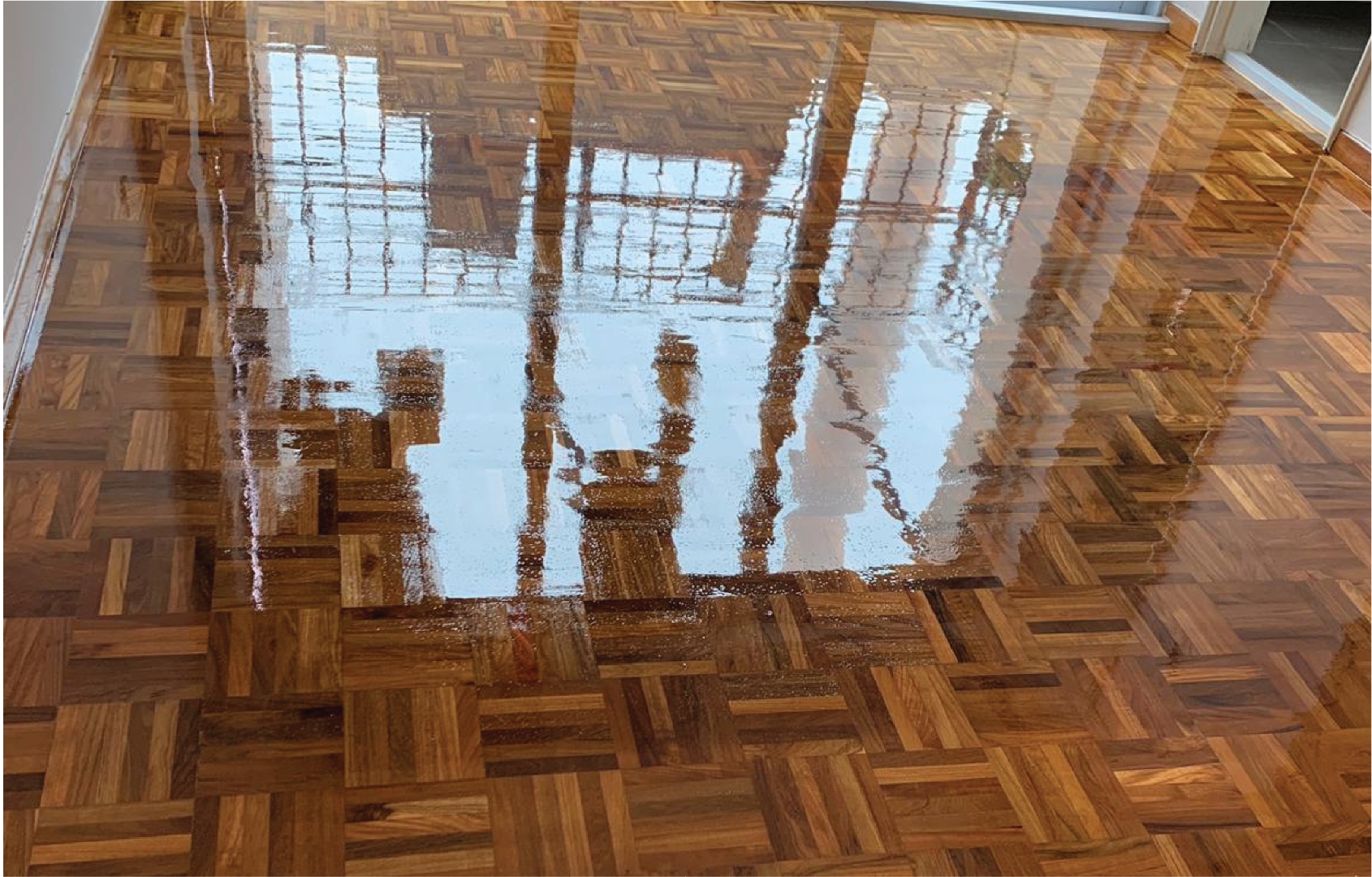
Water damage is the single biggest insurance-claimed event we see on Singapore wood floors. The most common causes are an aircon condensate pipe blockage, a slow leak under a kitchen sink, an overflow from a balcony planter, and a unit-above pipe leak that takes a week to be reported. By the time the floor is visibly cupped, swollen or stained, the question is no longer "will it be damaged" but "how much can be saved".
This article walks through the technical assessment we use on site, the moisture and timing thresholds that decide whether a floor dries out or needs partial replacement, and the standards we reference for measurement and repair.
Step 1 — find and stop the source
A wood floor cannot dry while the source is still wet. The first 24 hours decide a lot:
- Aircon condensate leaks usually trace to a blocked drainage pipe at the FCU. The pipe is cleared and the floor begins to dry the same day.
- Plumbing leaks behind cabinetry can wet the screed without visible surface damage for days. Lifting one or two parquet boards near the suspected source is sometimes the only way to confirm.
- Inter-unit leaks must be reported through the MCST and resolved before flooring work begins. We will not start a refurbishment on a wet substrate that has an active upstream source.
Photograph the visible damage and the moisture meter readings before any work begins — for insurance, for upstream-party responsibility, and for the contractor record.
Step 2 — measure, do not guess
Wood looks dry on the surface long before it is actually dry. We measure with a calibrated pin-type meter on the wood and with a non-invasive RH probe on the screed. The principle we follow is set out in ASTM D4442 Standard Test Methods for Direct Moisture Content Measurement of Wood and Wood-Based Materials and ASTM F2170 In Situ Probes Method for relative humidity of concrete slabs.
Indicative thresholds for parquet and timber on a concrete screed in Singapore:
- Wood at 8–12% MC — normal in-service range.
- Wood at 12–16% MC — elevated; varnish film is at risk of bond loss; floor will dry naturally if the source is removed.
- Wood at 16–20% MC — significant; cup and gap likely; sanding cycle compressed.
- Wood above 20% MC sustained for days — risk of fungal decay; board replacement increasingly likely.
- Screed at >80% RH using an in-situ probe — flooring should not be laid or recoated until this comes down.
These figures are working guidance. The hard threshold that decides repair vs replace is whether the wood comes back to under 14% MC within a reasonable drying window, not the peak reading on day one.
Step 3 — controlled drying
Wood floors do not want to be force-dried. Industrial fans at high speed and dehumidifiers running at 30% RH will dry the surface fast and check (split) the wood as it shrinks. The drying plan is gentler:
- Air movement with the unit's own fans and a couple of mobile fans, run continuously.
- A dehumidifier at 50–55% RH target, not lower. The goal is to lift damp air out of the boards, not to over-dry them.
- Aircon used as usual — the gentle dehumidification of a normal air-conditioned room is in fact useful.
- Drying time of 7–21 days depending on how much water and how long it sat. Faster than that and the cup pattern reverses to a crown as the surface tightens above a still-damp underside.
We monitor with daily meter readings. The floor is considered "dry" when readings across the affected area are within 2% of the readings on undamaged areas of the same unit and have been stable for 48 hours.
Step 4 — assess the damage, decide the scope
Once dry, the visible damage settles into one of four scope categories:
A. Surface staining only
The varnish has whitened, blackened or tide-marked but the wood is sound. Treatment: screen-and-recoat, or full sand-and-recoat if the staining is widespread. No board replacement. Same-species touch-up varnish blends within a coat or two.
B. Cup / crown only
Edges lifted or centres bowed, but no cracking and no permanent compression. Treatment: continue drying for 1–2 weeks beyond the apparent "dry" point. Many cups partially recover. Then sand flat — a flat sand can absorb up to 1.5 mm of remaining cup. Anything beyond that requires board replacement.
C. Board cracking, splitting or compression
Wood fibres have crushed or split. Permanent. Treatment: lift and replace the affected boards in matching species and grade. We hold stock of common species (Burmese teak, oak, walnut, merbau) and source matched boards for less common species. Replacement boards are sanded flush with the surrounding floor.
D. Decay / fungal damage / sustained wet
The wood is soft, dark, and gives off a damp-cellar smell. Treatment: lift and replace the affected zone, plus the visibly sound boards immediately adjacent — the fungus has often penetrated further than the visible stain. The screed underneath is checked, dried, and in heavy cases stripped back to a sound substrate. Where the damage is at a wet-zone boundary, the homeowner's waterproofing scope is reviewed against SS 637:2018 Code of Practice for Waterproofing of Reinforced Concrete Buildings before relaying.
Sanding and refinishing after water damage
A water-damaged floor that has reached scope category A or B is sanded and refinished using a standard sand-and-varnish cycle, with two adjustments:
- End-grit one step finer than a routine recoat — the wood surface is often slightly fuzzy or raised after drying.
- A sealer coat under the varnish to even out the porosity differences between wet-stressed boards and undamaged ones.
Where the floor is recoated rather than fully sanded, the coating system is matched as closely as possible to the existing finish. Mixed systems (water-based over an unknown oil-based) often need an intermediate sealer to bond reliably.
The sanding and finishing procedure follows the principles of AS 4786.2:2005 Timber — Sanding and finishing of timber floors — Procedures and inspection, which is the most widely-referenced practitioner document in the region for sanding-and-finishing workmanship.
Insurance, documentation and inter-party responsibility
Where the leak originates from another party (the unit above, an MCST common pipe, an appliance defect), the cost of repair is recoverable. We provide:
- Dated site photographs at first attendance.
- Moisture meter readings on the wood and screed at first attendance and at handover.
- A scope letter setting out which boards were replaced, the species and grade used, the coating system applied and the cure window.
- Tax invoice and warranty letter for the new work.
We do not act as the loss adjuster or arbitrate between parties; we provide the technical record the homeowner submits to their insurer.
What we recommend
- Stop the source, then measure, then dry. Do not start refurbishment on a floor that is still wet.
- Give the floor 1–3 weeks of monitored drying before deciding final scope.
- Match species and grade carefully on replacement boards; mismatched replacements stand out for years after a refinish.
- Walk through the upstream cause with the MCST or appliance contractor before the new floor goes down. A floor relaid on the same leaking pipe will fail in the same way.
We attend site at no cost for a written assessment and scope letter. Project-specific recommendations and pricing are confirmed in writing per job.
---
References used in this article
- ASTM International. ASTM D4442 — Direct Moisture Content Measurement of Wood and Wood-Based Materials.
- ASTM International. ASTM F2170 — Standard Test Method for Determining Relative Humidity in Concrete Floor Slabs Using in situ Probes.
- Standards Australia. AS 4786.2:2005 — Timber — Sanding and finishing of timber floors — Procedures and inspection.
- Enterprise Singapore. SS 637:2018 — Code of Practice for Waterproofing of Reinforced Concrete Buildings. Singapore Standards eShop.
- US Forest Products Laboratory. Wood Handbook (FPL-GTR-282, 2021), chapters on moisture and dimensional change. fpl.fs.usda.gov
Standards are referenced as named documents; full text is available from the issuing bodies and is not reproduced here.