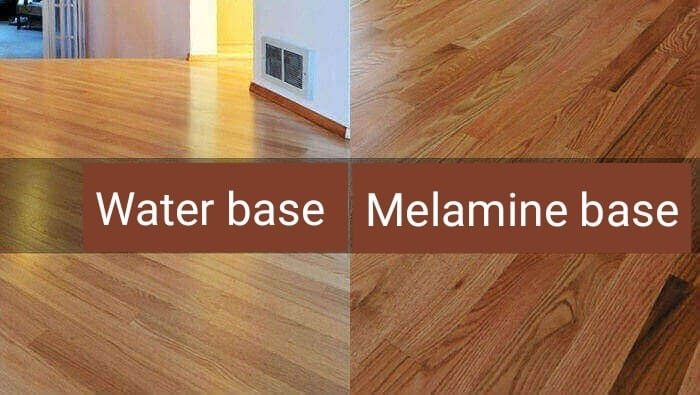
The choice of varnish on a wood floor is rarely a single-axis decision. Cost, indoor-air quality, wear performance, sheen, recoat life and how disruptive the application is to the homeowner all interact. This article sets out the three coating families we install most often in Singapore — single-pack water-based, single-pack oil-based and two-pack (2K) water-based polyurethane — against the published technical references that apply.
We work with both standard local products and the Bona system. The article below is product-neutral on brand and is focused on what the chemistry actually does on the floor.
The three families
Single-pack water-based polyurethane (1K WB)
A water-borne acrylic-polyurethane dispersion. Cures by evaporation of water and coalescence of the polymer particles. Mild odour, fast recoat (2–4 hours), good clarity. The local default for residential parquet today. Bona Domo, Pallmann Pall-X and various regional water-based PUs sit in this family.
Single-pack oil-based polyurethane (1K OB)
A solvent-borne alkyd-polyurethane. Cures by oxidation of the oil component. Stronger amber colour, slightly higher film build per coat, hard final surface. Long cure window and strong solvent odour for several days during application. The traditional Singapore parquet finish before water-based products gained share.
Two-pack water-based polyurethane (2K WB)
A water-borne polymer plus a separate isocyanate or aliphatic-isocyanate cross-linker mixed shortly before application. Cures by chemical reaction, not just evaporation. Significantly more chemical-resistant and abrasion-resistant film than 1K WB. Bona Traffic HD is the most recognised example; comparable 2K systems are available from other manufacturers.
VOC content and indoor-air
For interior wood-floor varnishes, the relevant published benchmark is EU Directive 2004/42/EC on the limitation of emissions of volatile organic compounds due to the use of organic solvents in certain paints and varnishes. Annex II sets ready-to-use VOC limits by product category. Indicative limits and where the three families typically fall:
- 1K WB residential floor varnish: limit 140 g/L; well-formulated products are 50–100 g/L.
- 1K OB residential floor varnish: limit 300–400 g/L depending on sub-category; typical solvent-borne PUs are 300–550 g/L.
- 2K WB residential floor varnish: limit 140 g/L; well-formulated products are 80–120 g/L (the isocyanate cross-linker is a small fraction of the mixed coating volume).
Singapore's domestic regulation tracks the same direction. From 1 January 2026, the National Environment Agency restricts the formaldehyde content of interior architectural paints sold in Singapore — see the NEA notification under the Environmental Protection and Management Act on www.nea.gov.sg. Wood-floor varnish is not the headline category for that rule, but it is worth knowing that the regulatory direction in Singapore is the same as the EU framework: lower solvent, lower carbonyl emissions, more weight on water-based chemistry.
For homes with infants, asthma sufferers or sensitive occupants, our default specification is a 1K WB system; 2K WB where wear performance justifies it. Oil-based is still a legitimate choice for a vacated unit being refurbished between owners but is no longer our recommendation for occupied homes.
Wear and abrasion performance
The standardised laboratory test for floor-coating wear in the wood-flooring sector is the Taber abrasion test, reported under ASTM D4060 or ISO 9352. Manufacturer data sheets typically state milligrams of weight loss per 1,000 cycles with a CS-17 wheel.
Indicative residential figures published by reputable manufacturers:
| Coating family | Taber CS-17, 1,000 cycles | Practical recoat interval |
|---|---|---|
| 1K WB, mid-tier | 60–80 mg loss | 3–4 years residential |
| 1K WB, premium | 30–50 mg loss | 4–5 years residential |
| 1K OB, premium alkyd-PU | 30–50 mg loss | 4–5 years residential |
| 2K WB, premium | 15–30 mg loss | 5–7 years residential |
These are laboratory numbers, not warranties. Real residential floors fail by scratch, dent and water-edge bond loss long before total abrasion reaches the Taber-test threshold. The number is still useful as a relative ranking between products.
Sanding and finishing workmanship — substrate flatness, grit progression, dust control between coats and inter-coat sanding — has at least as much effect on real wear life as the topcoat brand. Our sanding sequence follows the principles of AS 4786.2:2005 Timber — Sanding and finishing of timber floors — Procedures and inspection, which is the most widely-referenced practitioner document in the region for sanding-and-finishing workmanship.
Slip resistance and sheen
Slip resistance is set out in Singapore by SS 485:2022 Specification for slip resistance classification of pedestrian surface materials. Wood floors in normal dry interior use are well within the low slip risk dry category for matt, satin and most semi-gloss finishes. The picture changes when the floor is wet — at stair heads and balcony thresholds in particular, a matt or satin sheen is the practical specification, and a high-gloss finish should be discussed against the SS 485 framework before being specified.
A working rule of thumb:
- Matt (≤10 GU at 60°) — most slip-resistant, hides scratches, looks contemporary.
- Satin (10–35 GU) — the residential default in Singapore today. Balance of warmth and durability.
- Semi-gloss (35–70 GU) — traditional teak-parquet look, shows fingerprints and scratches.
- Gloss (>70 GU) — heritage / showroom; not our recommendation for a wet-threshold floor.
The gloss units quoted above use the principles of ASTM D523 / ISO 2813 Specular gloss. Manufacturer data sheets call out the value on the can; we confirm at quotation.
Application and cure timeline
Comparative timeline for a typical 80 m² parquet floor:
| Stage | 1K WB | 1K OB | 2K WB |
|---|---|---|---|
| Tack-free per coat | 1–2 h | 4–8 h | 1–2 h |
| Recoat window | 2–4 h | 16–24 h | 2–4 h |
| Three-coat day | Same day or next day | 2–3 days | Same day or next day |
| Light foot traffic | Day 2 | Day 3–4 | Day 2 |
| Furniture and rugs | Day 7–10 | Day 7–14 | Day 7 |
| Full chemical cure | 7–14 days | 14–28 days | 7 days |
| Site odour | Mild, 1–2 days | Strong, 3–5 days | Mild, 1–2 days |
The 2K WB has the shortest return-to-service window for an occupied home; 1K OB has the longest cure and is the most disruptive to live around. The 1K WB is the all-round middle ground and the default for routine residential refinishing.
Where each one fits
- 1K WB, 3 coats — default for bedrooms, study, light-traffic living rooms. Mild odour for occupied homes.
- 1K WB premium (e.g. Bona Domo), 3 coats — when budget allows a step up without a 2K commitment.
- 2K WB (e.g. Bona Traffic HD), 3 coats — high-wear living and dining areas, rolling-chair studies, commercial showrooms and high-end residences where the long recoat interval pays back.
- 1K OB, 3 coats — heritage projects asking for the traditional amber look; vacated units where the long cure window is not a problem; clients who specifically prefer the deeper colour development.
We recommend like-for-like sanding regardless of topcoat. The same prepared substrate accepts any of the three families; the wear life difference comes from the chemistry, not from cutting corners on prep.
What we recommend by room
- Master bedroom / guest bedrooms — 1K WB, satin sheen.
- Living and dining rooms — 1K WB premium or 2K WB, satin.
- Study with rolling chair, family corridor — 2K WB, satin. A chair mat under the rolling chair is still a good idea.
- Wet-threshold zones (balcony approach, kitchen entry) — 2K WB, matt. SS 485 considerations.
- Heritage parquet in landed property — 1K OB if the client wants the amber tone; otherwise 1K WB to keep the colour neutral.
We quote like-for-like across coating options so the choice is made on numbers, not on brand pressure. Project-specific recommendations and pricing are confirmed in writing per job.
---
References used in this article
- European Parliament and Council. Directive 2004/42/EC on the limitation of emissions of volatile organic compounds.
- National Environment Agency (Singapore). Formaldehyde content limit for interior architectural paints, effective 1 January 2026. www.nea.gov.sg
- Enterprise Singapore. SS 485:2022 — Specification for slip resistance classification of pedestrian surface materials. Singapore Standards eShop
- Standards Australia. AS 4786.2:2005 — Timber — Sanding and finishing of timber floors — Procedures and inspection.
- ASTM International. ASTM D4060 — Standard Test Method for Abrasion Resistance of Organic Coatings by the Taber Abraser.
- ISO. ISO 2813 — Paints and varnishes — Determination of gloss value at 20°, 60° and 85°.
Standards are referenced as named documents; full text is available from the issuing bodies and is not reproduced here.