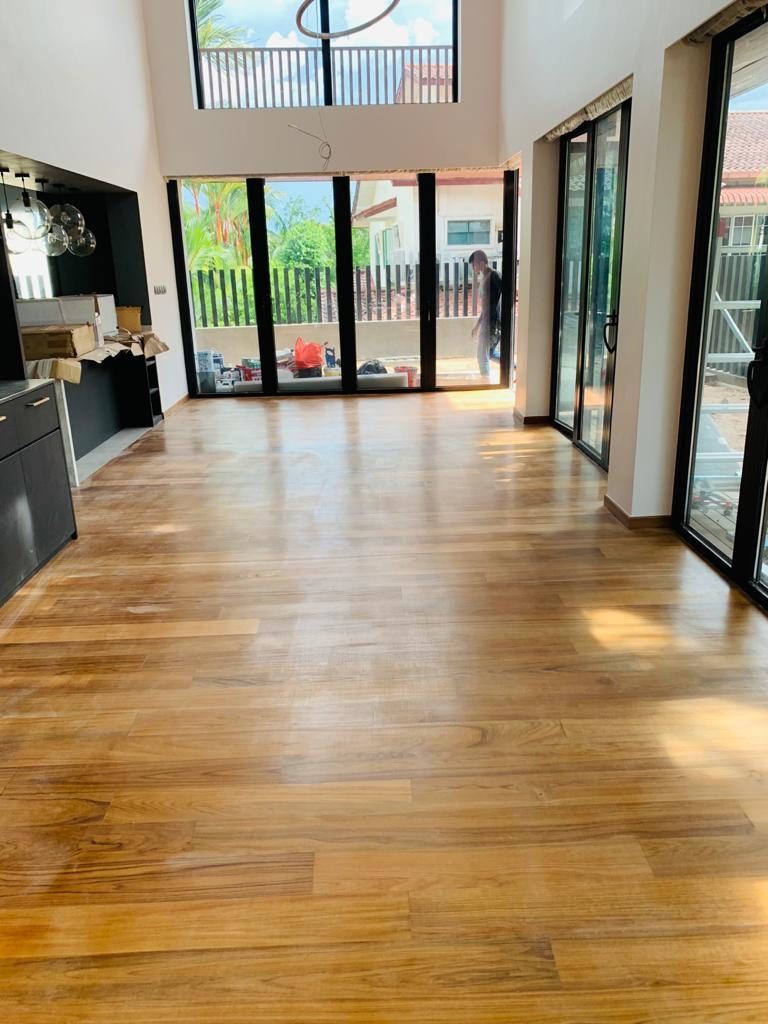
Termite damage is the most common biological risk to wood floors in Singapore. The two most active species in residential properties are the subterranean Coptotermes gestroi and the drywood Cryptotermes cynocephalus, and both make their way into buildings through ground contact, untreated timber and persistent moisture. This article sets out how species selection, published durability classes and moisture control reduce that risk on a parquet, solid timber or engineered wood installation.
Termite resistance is rarely an absolute property. A wood floor with the right species, kept inside a sensible humidity range, on a screed that does not stay wet, with the building treated to the Pest Control Act baseline, is a low-risk floor. A floor with the wrong species on a screed that leaks, with no termite barrier, can fail in five years. The decision is layered.
How wood is classified for biological resistance
Two reference documents come up:
- EN 350:2016 — Durability of wood and wood-based products — Testing and classification of the durability to biological agents. Classifies natural durability against decay fungi (Class 1 very durable to Class 5 not durable) and gives a separate scale for resistance to termites (DC — durable to termites, M — moderately durable, S — susceptible).
- ASTM D3345 — Standard Test Method for Laboratory Evaluation of Solid Wood for Resistance to Termites. A laboratory method that exposes wood samples to subterranean termite colonies under controlled conditions and grades the result.
The point of both standards is that "naturally durable" is a measurable property of the heartwood of certain species — not the marketing claim of a brand.
Species rated for termite resistance
For the parquet and timber species available in Singapore:
| Species | EN 350 decay class | Termite resistance | Notes |
|---|---|---|---|
| Burmese teak (*Tectona grandis*) | Class 1 (very durable) | DC (durable) | High silica and natural-oil content; long Singapore track record |
| Merbau (*Intsia bijuga / palembanica*) | Class 1–2 | DC (durable) | Heavy, very hard; high tannin content |
| Kempas (*Koompassia malaccensis*) | Class 2 | M (moderately durable) | Cost-effective hard parquet species |
| Iroko (*Milicia excelsa*) | Class 1–2 | DC | African hardwood with teak-like service record |
| European white oak | Class 2 | M | Heartwood only; sapwood is susceptible |
| American black walnut | Class 3 | M to S | Acceptable in low-risk dry interiors |
| Hard maple | Class 5 | S | Not recommended near wet thresholds |
| Untreated softwood / plywood substrate | Class 4–5 | S | Treat or isolate from ground contact |
Source: EN 350:2016 Durability of wood and wood-based products; species summaries cross-referenced with The Wood Database and FPL Wood Handbook (US Forest Service, FPL-GTR-282, 2021) — available from the US Forest Products Laboratory.
The published rating applies to heartwood. Sapwood from the same species is consistently more vulnerable, and a grading specification (FAS, Select, coeur uniquement, etc.) effectively decides how much sapwood you accept.
How termites actually get in
Three pathways dominate residential termite incidents in Singapore:
- Subterranean entry through the screed or skirting. Coptotermes gestroi nests in soil and reaches the wood floor through cracks in the slab, around services and along skirting voids. This is the dominant pathway in landed properties and ground-floor units.
- Drywood infestation through existing furniture or untreated wood components. Cryptotermes species can colonise small pockets of wood and need no ground contact. A new floor laid in a unit that already has infested furniture can be attacked from above.
- Damp, neglected zones. Wood that stays above ~20% moisture content for extended periods is far more attractive to termites and to decay fungi than wood kept inside the 8–12% range that finished interior floors normally hold.
The NEA framework for pest management in residences — published guidance under the Control of Vectors and Pesticides Act and Pest Control regimes — is the regulatory baseline for treatment. We are not a licensed pest-control operator and do not carry out chemical treatment; we coordinate with the homeowner's pest-control contractor where a project warrants it.
Practical risk-reduction measures
We apply or recommend a layered approach. Each individual measure reduces risk; the combination is what makes a floor genuinely low-risk.
Specification stage
- Pick a species in EN 350 Class 1–2 for heavy-use floors and accept that maple, walnut and similar lower-class species are appropriate only in controlled-humidity, low-risk rooms.
- Specify heartwood grades. A teak floor at FAS / Select grade is largely heartwood; an industrial grade contains visible sapwood that lowers the durability of the floor as a system.
- Avoid untreated plywood underlay in ground-floor or balcony-adjacent installs. Where engineered wood is used, the manufacturer's plywood core should be a hardwood plywood, ideally with documented preservative treatment if available.
Site stage
- Coordinate with the pest-control contractor before screeding in landed properties. Soil treatment or a physical termite barrier (stainless-steel mesh or graded-stone barrier) is most easily installed at slab stage. The relevant local context is referenced in the BCA Good Industry Practices guidance for new building work; we treat that as the architect's specification rather than something we add unilaterally.
- Confirm screed moisture before laying. A wet screed encourages mould first, then decay fungi, then termites. We measure with a calibrated meter and follow the principles of ASTM D4442 for moisture testing of wood and wood-based materials, and we ask for the screed's relative-humidity / hood-test result for the substrate.
Service-life stage
- Keep indoor RH in the 55–70% band. A dehumidifier in a chronically damp basement-level store is appropriate; running one 24/7 in an aircon-heavy condo is not.
- Inspect at sanding cycle. A wood floor that comes up for a full sand-and-coat every 10–15 years is also a chance to look for frass, mud tubes or hollow-sounding boards. We flag anything we see and recommend a pest-control inspection before recoating.
What we recommend
For new parquet and timber floors in Singapore, our default specification is:
- Burmese teak or merbau for traditional parquet in landed homes and heavy-use rooms.
- European white oak for contemporary plank work in well-managed humidity envelopes.
- Heartwood-grade boards with documented species and origin.
- A screed moisture record on file before laying.
- Pest-control coordination at construction stage in landed properties or where the building's history warrants it.
We do not represent any floor as termite-proof — no contractor honestly can. We do install with the species, grading and moisture record that reduce the realistic in-service risk to the level the published standards target.
Project-specific recommendations and pricing are confirmed in writing per job.
---
References used in this article
- BSI / CEN. EN 350:2016 — Durability of wood and wood-based products.
- ASTM International. ASTM D3345 — Standard Test Method for Laboratory Evaluation of Solid Wood for Resistance to Termites.
- ASTM International. ASTM D4442 — Direct Moisture Content Measurement of Wood and Wood-Based Materials.
- US Forest Products Laboratory. Wood Handbook — Wood as an Engineering Material (FPL-GTR-282, 2021). fpl.fs.usda.gov
- National Environment Agency (Singapore). Pest-management guidance under the Control of Vectors and Pesticides Act. www.nea.gov.sg
- Building and Construction Authority (Singapore). Good Industry Practices — referenced for termite-barrier and moisture-management practice. www1.bca.gov.sg
Standards are referenced as named documents; full text is available from the issuing bodies and is not reproduced here. We are not the licensed pest-control contractor on any project; chemical treatment is carried out by the homeowner's appointed pest-control operator under their NEA licence.